Estonian Music Days – day three, live on the radio
Estonian Music Days – day three, live on the radio
Apr 12 2015
planethugill.com
Robert Hugill
My last visit to Estonian Music Days in Tallinn saw me attending a live radio broadcast in Studio 1 of Estonian Public Broadcasting. Though the radio has a beautifully refurbished modern office (and I was privileged to get a trip roundKlassika Raadio’s 9th floor offices), the original post-war building (housing Studio 1) is still in use and about to be refurbished.
So on Sunday 12 April 2015, Tallinn Chamber Orchestra conducted by the young Latvian conductor Atvars Lakstigalaperformed a programme of music by Kristjan Randalu, Liisa Hirsch, Elis Hallik, Sander Pehk, Mariliis Valkonen,Helena Tulve and Kristaps Petersons with violinists Triin Ruubel and Juta Ounapuu-Mocanita. The music in the programme was mainly for strings, to which were added percussion at times. Though the programme was calledTwo Ladies there were in fact four violinists, as two of Triin Ruubel’s young pupils Triin Piirsalu and Triinu Veissmann played Sander Pehk’s piece as part of Mini-EMD. Remarkably, ALL the works in the programme were premieres.
We started with the premiere of Emigrane for string orchestra which was written in 2015 by Kristjan Randalu (born 1978). Using two contrasting ideas, vibrant polytonal chords and a more lyrical theme, Kristjan Randalu created a dynamic piece which had references to the style and genre of a variety of familiar string orchestral works.
The concert featured three works for orchestra with solo violin(s), with a solo work for each of Triin Ruubel and Jut Ounapuu, plus one with solos for both, and a work for both with no accompaniment. None of the concertante works was strictly a concerto and none use a traditional relationship between soloist(s) and orchestra. The first was Ascending…Descending for violin and chamber orchestra, written in 2015 by Liisa Hirsch (born 1984), with soloist Triin Ruubel. Liisa Hirsch’s programme note explicitly talked about re-defining the classical soloist-accompanist relationship (to which my slightly annoyed response would be, then why use a soloist at all!), and the soloist was essential primus inter pares, with little feel of either virtuosity, bravura or dominance. The opening material for the work was dominated by long string glissandi, and though it developed in intensity the result was an interesting concept rather than a gripping work.
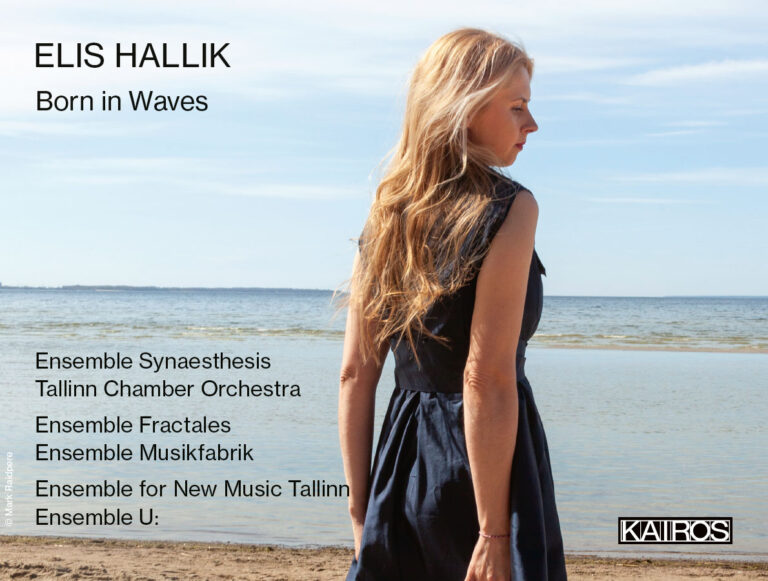
Next Force of Nature for two violins and chamber orchestra, written in 2015 by Elis Hallik (born 1986) used lyrical material pushed to the edge with a lot of high writing and some non-pitched effects. Though there were clearly themes in the high intensity piece, it was as much about textures as thematic or harmonic development. A nervous fidgety piece which became quite violent and was very up front
“Next Force of Nature for two violins and chamber orchestra, written in 2015 by Elis Hallik (born 1986) used lyrical material pushed to the edge with a lot of high writing and some non-pitched effects. Though there were clearly themes in the high intensity piece, it was as much about textures as thematic or harmonic development. A nervous fidgety piece which became quite violent and was very up front.”
The next work was the piece performed as part of Mini-EMD with the school girls Triin Piisalu and Triinu Veissmann giving a confident premiere to Eduard by the Brook written in 2015 by Sander Pehk (born 1990); the title refers to the Estonian composer Eduard Oja (1905-1950) whose surname means brook in Estonian.
Juta Ounapuu-Mocanita was the soloist in Fulfilment for solo violin and chamber orchestra (strings and percussion), written in 2015 by Mariliss Valkonen (born 1981). This started with a vigorous solo accompanied by just tuned percussion, there was a quiet, sustained response from the strings and the piece seemed to develop as a sort of call and response with the string responding in a slow sustained way to the soloist’s vigour.
Finally, after all the very up front works for solo violin(s) and orchestra, there was higher than the soul can hope and mind can hide for two violins, written in 2015 by Helena Tulve (born 1972). The work use lyrical expressionist motifs interweaving between the two violins, but there was also a use of silence making the work feel highly deliberate and highly thoughtful. After a few false endings, the two soloists ended up almost pitchless at the bridge.
The last work in the programme was the only Latvian work in the programme, one chosen by the composer. Chess by Kirstaps Petersons (born 1982) for chamber orchestra (strings and percussion) was written in 2010 but still receiving its premiere. The title refers to the chess player Mikhail Tal from Riga. It started with a lyrical melody over an ostinato, for just cello and vibraphone, but gradually more instruments joined in and the ostinato developed a highly catchy, multi-layered feel.
This was a strong, though rather long concert (one hour 45 minutes, without interval but with short breaks for the announcer and for interviews with composers), with a group of very strong, very forceful pieces which seemed to allow little in the way of drawing the audience in, you had to work on each piece. It was a relief, towards the end, to come across Helena Tulve’s piece which seemed to engage rather than demand, whilst the final work came as a feeling of light relief.
After the concert, another journalist from London (Gavin Dixon) and I were taken on a tour of the new Klassika Radio studios at the top floor of their newly refurbished building (with superb views despite the grey weather) and we did a short interview about the festival which will be broadcast next weekend.
This concluded my visits to the events of Estonian Music Days. Over the space of three days I had heard 24 pieces performed live (with 16 premieres), an incredible amount of music. And that wasn’t all. Because of the festival programming, I was unable to get to the second concert on the Sunday. And that was one of the problems. In their eagerness to show the best of the vibrant Estonian new music scene, we were presented with rather too much music in concerts that were a little too long.